
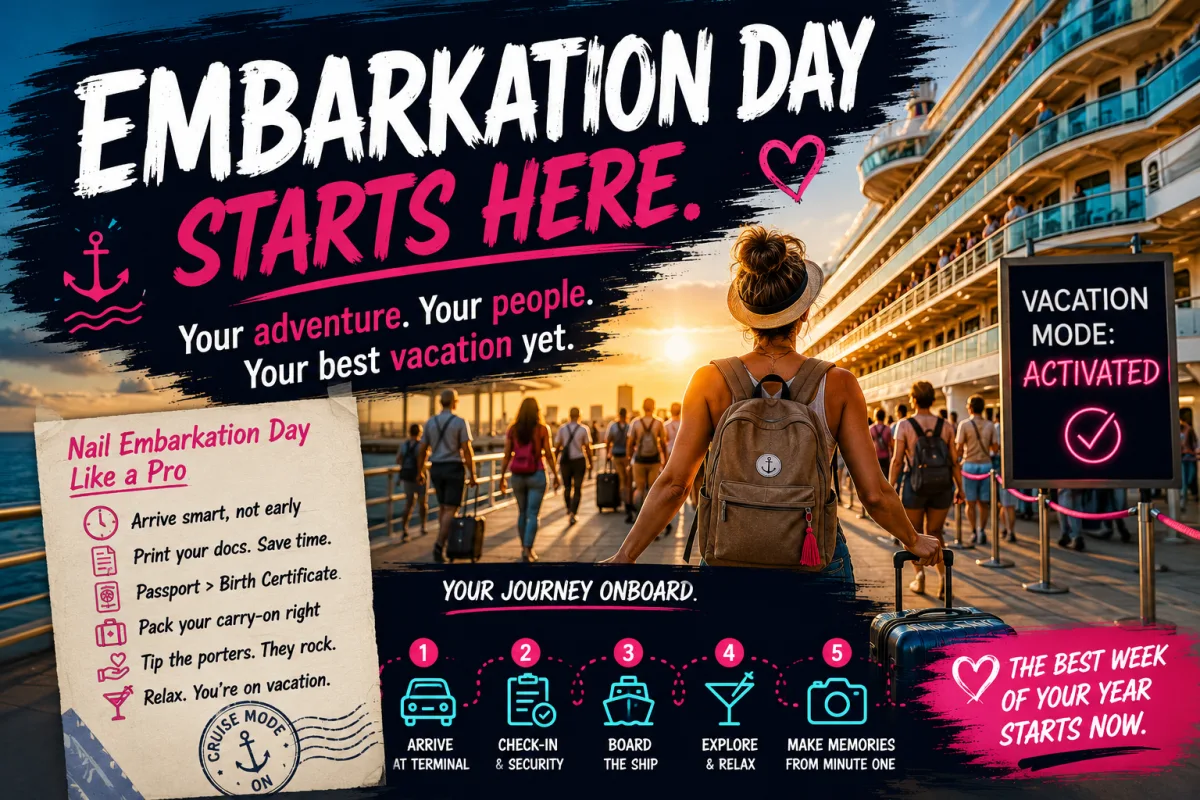
You made it.
After months of researching cruise lines, comparing itineraries, watching YouTube cabin tours at two in the morning, and wondering whether you really need six swimsuits for a seven-day cruise — Embarkation Day has finally arrived.
For a lot of first-time cruisers, it's also the most stressful day of the entire vacation.
Thousands of people are arriving at the terminal at once. Everyone seems to know exactly where they're going except you. Luggage is moving in every direction, somebody is shouting about boarding zones, and your phone has suddenly decided it can't find your boarding pass.
And you're standing there quietly wondering whether you've forgotten the one document that decides whether you get on this ship or spend the week watching it leave without you.
Relax. Take a breath.
After more than twenty-five cruises, I can tell you something that might surprise you.
Embarkation Day is only stressful if you fight it.
Once you understand how the day actually works, it stops being an obstacle and becomes one of the best parts of the whole trip.
Stop Trying to Be First
This is the single biggest mistake I see first-time cruisers make.
Everyone wants to board first. People show up hours before their assigned arrival time. They buy priority boarding because they're convinced that getting onboard thirty minutes earlier will somehow change their vacation.
Sometimes it does.
Usually, it just gets you into a longer buffet line.
Here's the thing nobody says out loud: whether you board at 11:00 or at 1:00, the ship is not leaving without you. Your vacation starts when you decide it starts — not when your boarding group is called.
If you genuinely hate queueing, priority boarding packages can be worth a look. Carnival has Faster to the Fun; Royal Caribbean sells The Key on most sailings; premium experiences like NCL's Haven and MSC's Yacht Club include priority embarkation automatically.
But be clear-eyed about what you're buying. Royal Caribbean's The Key runs roughly $25 to $50 per person, per day — and every guest aged six and over in your cabin has to buy it too. The most commonly cited reason experienced cruisers give for buying it isn't the boarding at all. It's the Wi-Fi. Even Royal Caribbean's own community will tell you that their standard boarding process is efficient enough that Key holders often board only a few minutes ahead of everyone else.
You're buying convenience. You are not buying extra vacation.
Personally? I'd rather spend ten fewer minutes in a terminal than forty extra minutes in line at Guy's Burgers because two thousand people had the same idea I did.
Jay's Tip Don't measure your vacation by how quickly you get onboard. Measure it by how quickly you stop checking your watch.
The Night Before Matters More Than the Morning
The smoothest embarkations begin before you ever leave the hotel.
The night before, get everything in one place: print your boarding documents, attach your luggage tags, charge your phone, and set out your passport. Put your medications in your carry-on — not in the checked bag. And check, twice, that your swimsuit is somewhere other than the suitcase you're about to hand to a porter.
Trust me on that last one.
Watching everyone else float around the pool with a frozen drink while you're standing there in jeans, because your suitcase is still somewhere in the bowels of the ship, is a very specific kind of torture.
Jay's Tip Your swimsuit belongs in your carry-on. So do your medications, your documents, and anything you genuinely cannot replace. Ask yourself one question while you're packing: if my suitcase vanished until dinner, would I still be fine?
Yes — Actually Print Your Boarding Documents
I know. It's 2026. Everything lives on our phones.
Until it doesn't.
Cruise terminals are thousands of people all hammering the same cell towers at the same time. Batteries die, apps crash, email refuses to load, and QR codes turn into grey rectangles. Meanwhile, the couple next to you with a printed boarding pass walks straight through check-in while everyone else is frantically refreshing Gmail.
Terminals have improved a lot over the years, but plenty still run on equipment that is not exactly cutting edge.
Sometimes paper is simply faster.
Jay's Tip I have watched entire families spend fifteen minutes hunting for a confirmation email while the person holding a printed boarding pass was already halfway up the gangway. Old-school still wins more often than it should.
Bring a Passport If You Possibly Can
Many closed-loop cruises from U.S. ports — sailings that leave from and return to the same American port — allow U.S. citizens to travel with a government-issued photo ID and an original birth certificate.
Legally, that's fine. Personally, I'd still bring a passport every single time.
Not because the cruise line prefers it, but because everything else becomes easier.
If your ship returns to a U.S. port using facial recognition, a passport usually makes disembarkation noticeably quicker. And if something goes wrong — you miss the ship in a foreign port, you have a medical emergency overseas, you need to fly home unexpectedly — a passport is the difference between a bad afternoon and a genuinely awful week.
You may never need it. I sincerely hope you don't.
But it's one of those things you'll be extremely glad you brought if the trip takes an unexpected turn.
The Most Underappreciated People at the Terminal
Before you ever set foot on the ship, you'll meet the luggage porters.
Treat them well. They're moving thousands of bags in a very short window, usually outdoors, in whatever weather decided to turn up that morning. A few dollars per bag is customary and genuinely appreciated.
Does tipping guarantee your luggage arrives first?
Of course not.
Does my luggage nevertheless seem to appear mysteriously early on almost every cruise I've taken?
...I'm not willing to run the experiment.
Congratulations — You're Onboard
Now what?
Here's my entirely unsolicited advice: do not sprint to the buffet. Half the ship is already headed there, dragging carry-ons behind them, and it is the least relaxing room on the vessel for the next ninety minutes.
Instead, walk. Explore. Learn the layout while the public spaces are still half empty. Find the bar you're going to become a regular at. Book specialty dining and reserve any shows that need reserving — do it now, while everyone else is queueing for a burger. Take your photos before the decks fill up.
The buffet will still be there in twenty minutes. It is, famously, always there.
Your Cabin Probably Isn't Ready Yet
Don't panic if you can't get into your room straight away.
Cruise lines spend the late morning and early afternoon turning over several thousand staterooms between one sailing and the next, which is a genuinely enormous operation. Cabins typically open in the early afternoon.
Use that window to explore rather than standing outside your door willing it to unlock early. It will not unlock early.
Don't Skip the Muster Drill
Nobody loves a safety briefing. Nobody.
But it's mandatory, and it exists for a very good reason. The good news is that most cruise lines now run electronic muster drills — you watch a short safety video on your phone or cabin TV and check in at your assigned station — which is dramatically faster than the old business of herding four thousand people onto a deck in lifejackets.
Get it done early. Then forget about it.
Vacation officially begins.
The Biggest Rookie Mistake
People wait.
They wait for their luggage. They wait for their cabin. They wait for sail-away. And — this is the expensive one — they wait until tomorrow to start talking to anybody.
Then suddenly it's Day Four, and they're watching a group of people who clearly met on Day One howling with laughter at the piano bar, wondering how on earth that happened.
It happened because those people started on Day One. That's the whole trick, and I've written about how to meet people on a cruise at length, because the window for it closes far faster than anyone expects.
The other half of the trick is to start before you board at all. That's what Cruise Roll Calls have been for since the 1990s, and it's what CruiseHuddle does now — find your exact sailing, see who else is going, and walk onto that ship already knowing a few names.
Jay's Tip One of my favorite traditions: get a drink, find a quiet spot on an outside deck, and just watch everyone else arrive. Kids seeing their first cruise ship. Couples taking selfies. Families laughing at nothing in particular. You can literally watch vacation replace everyday life in real time. That's the moment it hits me: I'm back.
Embarkation Day Isn't About Boarding a Ship
It's about leaving everything else behind.
Months ago, this vacation existed only as an idea — a browser tab, a spreadsheet, a conversation over dinner. Now you're standing on a deck with the ocean stretching out in front of you.
Your phone matters a little less. Work feels very far away. The biggest decision you'll make for the next seven days might be frozen margarita or piña colada.
Embarkation Day isn't something to survive.
It's the first chapter of what will probably become one of your favorite memories.
Slow down. Look around. Take it in.
The ship will wait.
Your vacation already started.