From Corkboards to CruiseHuddle: How Cruise Communication Finally Got Its Shit Together
From printed cruise newsletters and clunky onboard apps to Cruise Critic roll calls, Facebook groups, Reddit bots, and CruiseHuddle—here’s how passenger communication at sea evolved.
For an industry built around putting thousands of people on one giant floating playground, cruise ships have historically been spectacularly bad at helping those people find each other.
Cruise lines mastered midnight buffets, Broadway productions, robot bartenders, waterslides, casinos, ice rinks, racetracks, and toilets capable of swallowing a small bath towel with the fury of Poseidon.
But helping passengers meet other passengers?
Apparently, that was the impossible part.
For more than four decades, cruise communication evolved from paper newsletters to television screens, smartphone apps, online forums, Facebook groups, Reddit communities, and barely functional onboard messaging.
Every generation promised to make cruising more connected.
Most just found a more technologically advanced way to tell you what time bingo started.
Here is the long, strange timeline of how cruise passengers communicated—and how we eventually arrived at CruiseHuddle.
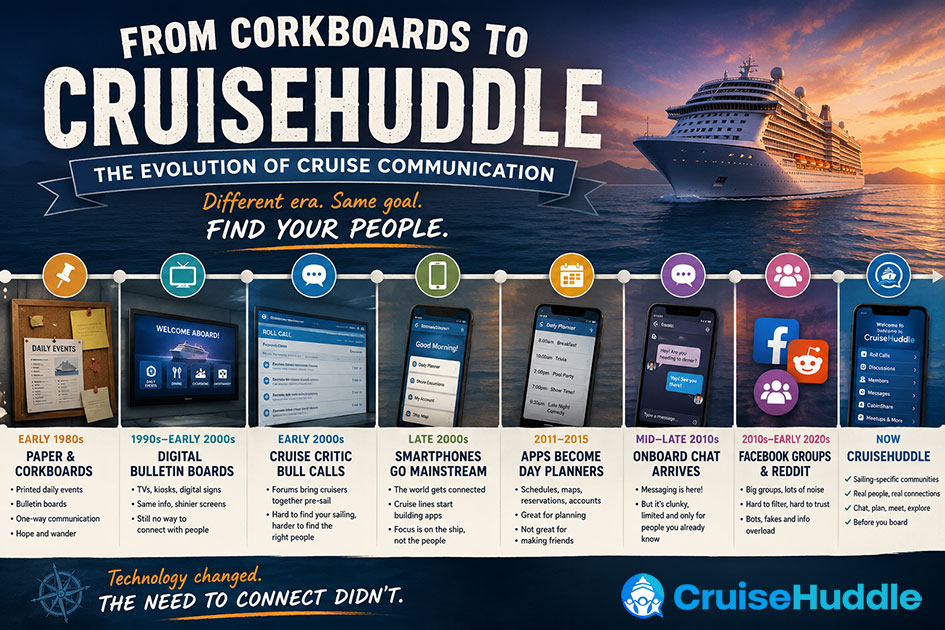
Early 1980s: Paper, Corkboards, and Blind Faith
In the early 1980s, cruise communication was about as sophisticated as a community-center bake sale.
Passengers received printed schedules listing the day’s activities, dining hours, entertainment, port information, and important announcements.
Different cruise lines eventually gave these daily publications cheerful branded names:
- Cruise Compass
- Princess Patter
- Freestyle Daily
- Fun Times
- When & Where
They were essentially newspapers for a tiny floating civilization.
Want to know when the midnight buffet opened? Read the paper.
Want to know where trivia was happening? Read the paper.
Want to meet other passengers interested in snorkeling, card games, singles events, LGBTQ+ gatherings, or splitting an excursion?
Check a bulletin board, look for a handwritten note, or wander around the ship hoping fate—and possibly several piña coladas—would handle the introduction.
The system worked reasonably well for broadcasting information.
It was absolutely useless for discovering people.
Cruise communication was one-way:
The ship talked. Passengers listened.
There was no search. No filtering. No profile. No way to determine whether anyone else onboard shared your interests unless you physically showed up somewhere and inspected the room like a nervous meerkat.
The 1990s and Early 2000s: Congratulations, the Corkboard Has Pixels
As ships became larger and technology improved, cruise lines began replacing some physical notices with digital signage, interactive kiosks, and information delivered through stateroom televisions.
Passengers could receive ship information, preview excursions, order services, and review onboard offerings without leaving their cabins.
This felt futuristic at the time.
Instead of walking down the hall to stare at a bulletin board, you could sit on your bed and stare at a television.
Progress!
Digital displays were cleaner, easier to update, and less likely to have someone’s handwritten bridge-club announcement stapled crookedly across the dinner schedule.
But socially, nothing had changed.
The television knew what time the comedy show started.
It did not know that six other solo travelers wanted someone to join them for dinner.
The kiosk could sell you an excursion.
It could not introduce you to three people on your sailing who also wanted to book that excursion privately.
Cruise lines had digitized the bulletin board without addressing its biggest limitation:
It was still a bulletin board.
Early 2000s: Cruise Critic Roll Calls Enter the Chat
Then the internet began doing what cruise lines had failed to do: helping passengers connect before the ship sailed.
Cruise Critic Roll Calls allowed passengers booked on the same sailing to find one another, exchange information, organize meet-and-greets, and plan independent excursions.
This was a major improvement.
For the first time, cruisers could potentially meet people before embarkation instead of relying on a handwritten note beside the shuffleboard court.
Roll Calls helped passengers organize:
- Meet-and-greets
- Group excursions
- Cabin crawls
- Slot pulls
- Dining groups
- Informal gatherings
But the system was built like an old-school message board because, well, it was an old-school message board.
Finding your sailing could involve navigating cruise-line forums, ship categories, departure dates, thread titles, and pages of conversations.
Once inside, everyone was dumped into the same sprawling thread.
Looking for another solo traveler?
Start scrolling.
Looking for families with teenagers?
Keep scrolling.
Looking for someone around your age who wants to split a private excursion?
Clear your afternoon. You’re scrolling.
Roll Calls proved that cruise passengers desperately wanted to connect.
They also proved that an endless forum thread is not the same thing as a searchable social network.
It was better than a corkboard.
But structurally, it was still a corkboard with usernames.
Late 2000s: Everyone Gets a Smartphone—Except the Cruise Ship
As smartphones became part of everyday life, communication on land transformed almost overnight.
People could text friends, join communities, share locations, create events, discover nearby businesses, and connect with complete strangers who shared obscure interests.
Meanwhile, cruise passengers were still printing documents, carrying folded schedules, and paying horrifying amounts of money for internet access that moved at the approximate speed of continental drift.
The technology existed.
The cruise industry just had not figured out what to do with it.
When cruise-line apps began appearing, most focused on administrative tasks:
- Checking in
- Viewing reservations
- Booking excursions
- Reviewing schedules
- Checking onboard spending
- Looking at deck maps
These were useful tools.
They were also basically remote controls for your cruise reservation.
The apps helped passengers interact with the cruise line.
They did very little to help passengers interact with one another.
2011–2015: Cruise Apps Become Digital Day Planners
During the first half of the 2010s, onboard cruise apps started becoming more capable.
Passengers could carry the ship’s activity schedule, deck plan, account balance, dining information, and excursion catalog in their pockets.
But once again, cruise technology focused primarily on logistics.
The apps answered:
- Where is dinner?
- When is the show?
- How much money have I recklessly spent?
- Where the hell is Deck 6?
They generally did not answer:
- Who else is on this sailing?
- Who wants to meet for drinks?
- Are there other solo travelers onboard?
- Who wants to share transportation at the next port?
- Is anyone looking for a trivia team?
- Who wants to organize a meetup without screaming into a 5,000-person Facebook group?
Cruise apps were becoming very good at helping passengers manage a vacation.
They were not built to help passengers build relationships.
Mid-to-Late 2010s: Onboard Chat Arrives—Technically
Eventually, several cruise-line apps added passenger messaging.
On paper, this sounded like the missing piece.
In practice, onboard chat often required every participant to:
- Download the correct app.
- Connect to the ship’s internal Wi-Fi.
- Activate the messaging feature.
- Possibly pay an additional fee.
- Add or identify the other passenger.
- Keep the app running properly.
- Hope notifications arrived before everyone disembarked.
Passengers have repeatedly complained about inconsistent notifications, delayed messages, confusing setup, and apps that seem to stop working the moment they are actually needed.
More importantly, these systems were designed mainly for people who had already met.
You could message your spouse.
You could message your children.
You could message the friends traveling in another cabin.
Wonderful.
But the app still did not help you discover the interesting people in the other 2,000 cabins.
Cruise lines had finally built chat—but not social connection.
They created a digital walkie-talkie and declared the problem solved.
The Facebook Group Era: Everybody Into One Giant Room
As Cruise Critic participation became less consistent, Facebook Groups emerged as a popular alternative for sailing-specific communities.
They were easier to create, familiar to millions of users, and often more active than traditional forum Roll Calls.
But Facebook Groups inherited many of the same structural problems.
Everyone is thrown into one enormous feed.
A post asking about excursion partners disappears beneath:
- Drink-package questions
- Cabin-upgrade screenshots
- Weather speculation
- Matching-shirt announcements
- Someone asking whether the ship provides towels
- The same passport question for the seventeenth time
- A travel agent pretending not to advertise
- Gary posting a blurry photo of the ship from 2019
There is rarely meaningful filtering by traveler type, age range, interests, relationship status, group composition, or what someone actually wants to do.
Privacy is another problem.
Many travelers do not want their personal Facebook identity, family photos, employer information, hometown, political arguments, and fifteen years of questionable memes exposed to hundreds of strangers simply because they want someone to join them for snorkeling.
Facebook Groups can create conversation.
They were never designed specifically for cruise connection.
The Reddit Era: Anonymous, Chaotic, and Crawling With Questionable Humans
Reddit cruise communities became another place for passengers to research ships, ask questions, share experiences, and occasionally look for people on upcoming sailings.
The anonymity can feel more private than Facebook.
It also makes it considerably harder to know whether the person responding is:
- A real passenger
- A travel marketer
- A karma-farming bot
- A scammer
- Someone who has never boarded a cruise ship
- Three raccoons sharing a keyboard
Even where sailing-specific posts are permitted, they suffer from the same discovery problem.
Posts sink.
Search results become outdated.
There is no dependable passenger directory organized around an exact sailing.
There is no practical way to filter thousands of anonymous accounts into:
Real people on my ship who want to do the same shit I do.
CruiseHuddle members have told us that nearly 95% of the responses they received from some Reddit-based connection attempts appeared fake, automated, promotional, or otherwise suspicious.
That figure is based on member experiences, not an independent platform-wide audit.
But the frustration behind it is very real.
When you are trying to find an excursion partner, cabinmate, dinner companion, or new friend, “this account might be a bot wearing a captain’s hat” is not a reassuring starting point.
Then Came CruiseHuddle
CruiseHuddle was not created because cruise passengers lacked places to post things.
The internet already had plenty of places to post things.
CruiseHuddle was created because cruisers lacked a social network organized around the one detail that actually matters:
Their Exact Sailing
Not merely the cruise line.
Not merely the ship.
Not merely the destination.
The actual voyage they booked.
CruiseHuddle brings cruise travelers together before embarkation so they can discover people who are genuinely relevant to their trip.
Passengers can:
- Join sailing-specific communities
- Create traveler profiles
- Participate in Roll Calls
- Message privately
- Discuss itineraries
- Organize meetups
- Plan shore excursions
- Find dining companions
- Explore cabin-sharing opportunities
- Make friends before boarding
Solo travelers can find other solo travelers.
Couples can meet other couples.
Families can connect with families.
First-time cruisers can ask experienced passengers for help.
Travelers can find dining companions, activity partners, excursion groups, new friends, or potential cabin-sharing opportunities through CabinShare.
Instead of yelling into a generic forum and hoping the right person wanders past, CruiseHuddle gives passengers a community designed specifically for cruising.
That distinction matters.
Cruise Critic added conversations to cruise planning.
Facebook added cruise planning to a general social network.
Reddit added anonymity, chaos, and a suspicious number of robots.
Cruise-line apps added messaging for people who already knew one another.
CruiseHuddle starts with connection.
Because the real problem was never that passengers could not send a message.
The problem was finding the right person to message.
Forty Years of Innovation—and We Finally Found the People
Cruise communication has come a long way.
We went from printed activity sheets and physical bulletin boards to interactive televisions, digital signage, smartphone apps, onboard Wi-Fi, online forums, social groups, and passenger chat.
But nearly every step focused on delivering more information.
Very few focused on building meaningful connections.
Cruise lines became excellent at telling passengers what was happening.
They remained strangely indifferent to helping passengers decide who to experience it with.
That is the gap CruiseHuddle was built to close.
Because cruises are already social environments.
Thousands of people are eating, exploring, celebrating, drinking, dancing, relaxing, and making memories within a few hundred feet of one another.
They should not have to rely on luck, outdated forum threads, invasive Facebook Groups, unreliable onboard chat, or a Reddit account named DefinitelyNotABot8472 to meet.
The future of cruising is not another digital schedule.
It is not another generic message board.
It is not another app that shows your onboard balance while ignoring the fact that you have nobody to join you at dinner.
The future is Connected Cruising:
Discovering your people, connecting before departure, planning together, sailing together, and staying connected after the ship returns to port.
The technology took forty years to catch up.
Your next cruise should not.